Romantic greenways and historic rural landscapes in France and Italy
by
European Greenways Association
Description
The European Greenways Association (EGWA) was established in 1998 in Namur (Belgium) with the aim of promoting the creation and development of greenways across Europe. Today, it brings together nearly 50 organisations from 17 European countries involved in greenway development.
Imagine traveling by bike or on foot along charming rivers and canals, from the mountains to the coast, on greenways built along former railway lines and towpaths. These routes connect historic towns and traditional villages and reveal the industrial heritage of Europe's rivers and railways. They also lead to picturesque castles (French châteaux and Italian castelli), vineyards, gardens and a colorful patchwork of countryside, with delicious local produce and cuisine all along the way.
Greenways in France
France has developed one of Europe's largest greenway and cycle route networks, with more than 27,000 kilometers of national, regional and local routes. Much of the network is made up of traffic-free greenways along former railway lines, canal towpaths and river corridors. Other sections use quiet rural roads.
The French Association for the Promotion of Cycle Routes and Greenways (AF3V) is the leading organization working to develop, improve and promote greenways (voies vertes) and cycle routes (véloroutes) in France. Its interactive online map covers thousands of kilometers of routes across the country. It gives detailed information on surfaces, traffic conditions, accessibility and nearby attractions.
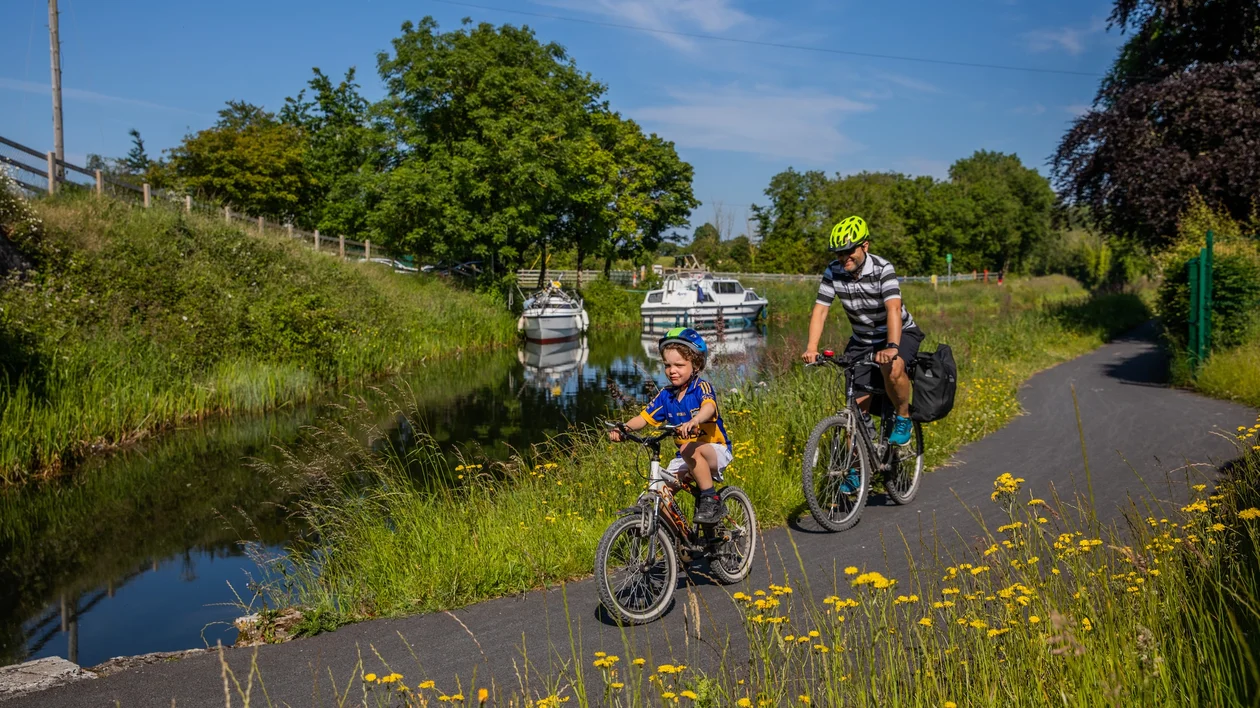
An adult and child cycle along a traffic-free path beside a narrow waterway, showing the more relaxed and accessible side of greenway travel.
La Loire à vélo: cycling through the Loire Valley
La Loire à Vélo is France's most famous cycling route. It brings together active travel, cultural heritage, nature conservation and sustainable tourism. The route follows the Loire River for about 900 kilometers, from the upper Loire near Nevers to the Atlantic coast at Saint-Brevin-les-Pins. Along the way it crosses the Centre-Val de Loire and Pays de la Loire regions.
La Loire à Vélo is part of EuroVelo 6 (Atlantic–Black Sea) and suits leisure cyclists, families and cycle tourists alike. It combines traffic-free greenways and riverside paths with carefully chosen quiet rural roads. The route is best known for pairing cycling with the exceptional cultural heritage of the Loire Valley, a UNESCO World Heritage-listed landscape. Cyclists can explore historic cities such as Orléans, Blois, Tours and Angers, and world-famous châteaux including Chambord and Villandry. Vineyards, traditional villages, river scenery, wetlands and protected natural areas line the route.
The Orléans canal cycle route (Loiret)
The Orléans Canal Cycle Route (La Véloroute du Canal d'Orléans) is one of France's newest greenways. It runs for 78 kilometers from Orléans, a city closely associated with Joan of Arc, to Châlette-sur-Loing near Montargis. Châlette-sur-Loing is an important historic waterway junction where the Canal de Briare, the Canal d'Orléans and the Canal du Loing meet. The route is in the Loiret department of the Centre-Val de Loire region.
The trail follows the peaceful banks of the canal, which dates back to the 17th century. It showcases the canal's unique heritage and hydraulic engineering, which once played an important role in carrying wood from the Forest of Orléans to Paris. Along the way, the greenway links forests, old locks and historic villages.
The route is also an important link between two major French cycle routes: La Loire à Vélo (EuroVelo 6) and La Scandibérique (EuroVelo 3). This voie vertewas designed to support sustainable tourism by combining active travel with protecting the canal's natural and historic setting. There are nine rest areas along the way, and the greenway is easy to reach by train, with stations in Montargis, Briare, Gien and Orléans.
La Véloferrée Greenway (Normandy)
In Normandy, the peaceful 42-kilometer La Véloferrée Greenway, formerly known as the Voie Verte de la Vallée du Bec, is not to be missed. It is still relatively little known, which keeps the setting quiet and picturesque.
The route follows a former railway line from the picturesque village of Pont-Authou to Évreux, capital of the Eure department. Pont-Authou is known for its industrial heritage linked to the Risle River and its mills, and it is where the greenway joins the Véloroute de la Risle. Évreux combines a rich architectural heritage, including the impressive Notre-Dame Cathedral, with the beautiful landscapes of the Iton Valley.
Heritage highlights along the greenway include:
Le Bec-Hellouin, one of France's officially recognized "Most Beautiful Villages," with its historic abbey
Harcourt, with its medieval castle set in a beautiful arboretum
The Domaine du Champ de Bataille, described as Europe's largest private garden, with four kilometers of views across formal French gardens, 20 fountains and an 18th-century château
La Trans-Ardennes Greenway (Grand Est)
In northeastern France, the cross-border La Trans-Ardennes Greenway follows the former Meuse towpath for 31.5 kilometers. It runs between Givet, on the Belgian border, and Mouzon, in the Ardennes department of the Grand Est region. Mouzon combines medieval heritage, religious architecture and industrial history, and holds the title "Petite Cité de Caractère" ("Small Town of Character").
The greenway offers a smooth, largely traffic-free ride through a steep, wooded valley. Cyclists pass historic towns and villages, former waterway and industrial sites, and locks, bridges and tunnels, while boats still travel the river alongside them. The route is part of EuroVelo 19, La Meuse à Vélo, and connects with the Belgian RAVeL network in Wallonia.
Via Fluvia: from the Loire to the Rhône (Auvergne-Rhône-Alpes)
If you love mountain scenery, try the Via Fluvia, which runs "from the Loire to the Rhône" for about 100 kilometers. It links the historic town of Yssingeaux with the village of Riotord, home to the Romanesque Church of Saint-Jean-Baptiste. Following a former railway line, the route crosses magnificent mid-mountain landscapes at 850–950 meters above sea level. It runs between the foothills of the Pilat Mountains and the volcanic landscapes of the Sucs and Emblavez area, toward the still-wild Loire River.
The Via Fluvia crosses the Haute-Loire, Loire and Ardèche departments, all in the Auvergne-Rhône-Alpes region. The scenery is remarkably varied, with forests, valleys, lakes and distinctive volcanic formations. Cyclists can explore historic towns and villages, local traditions and gastronomy, along with fascinating railway heritage such as former stations, viaducts, bridges and tunnels. Highlights include the impressive La Chapellette Viaduct and the historic Eiffel-style footbridge over the Lignon River at Pont de l'Enceinte.
With its mix of outdoor recreation, nature, culture and local heritage, the Via Fluvia appeals to ecotourists. The route can also be reached by TER regional train at Lavoûte-sur-Loire station.
The Baïse Valley Greenway (Nouvelle-Aquitaine)
For a taste of Gascony's landscapes and heritage, try the new 27-kilometer Baïse Valley Greenway (V82 – Voie Verte de la Vallée de la Baïse). It links the village of Feugarolles, home to the elegant 18th-century Château de Trenquelléon, with the picturesque hilltop village of Moncrabeau.
This smooth, traffic-free route follows a former railway line through the heart of the Albret area, in the Lot-et-Garonne department of Nouvelle-Aquitaine. It winds through quiet woodlands, vineyards and open countryside, with beautiful views of the Baïse River. Along the way, cyclists can discover the fortified bastide town of Vianne and riverside Lavardac. They also pass historic Nérac, with its colorful market of local products, its Château Henri IV and the romantic Parc de la Garenne.
The route connects with La Scandibérique (EuroVelo 3) and is being extended toward the Canal des Deux Mers à Vélo (V80). That will strengthen its role as an important link in France's long-distance cycling network.
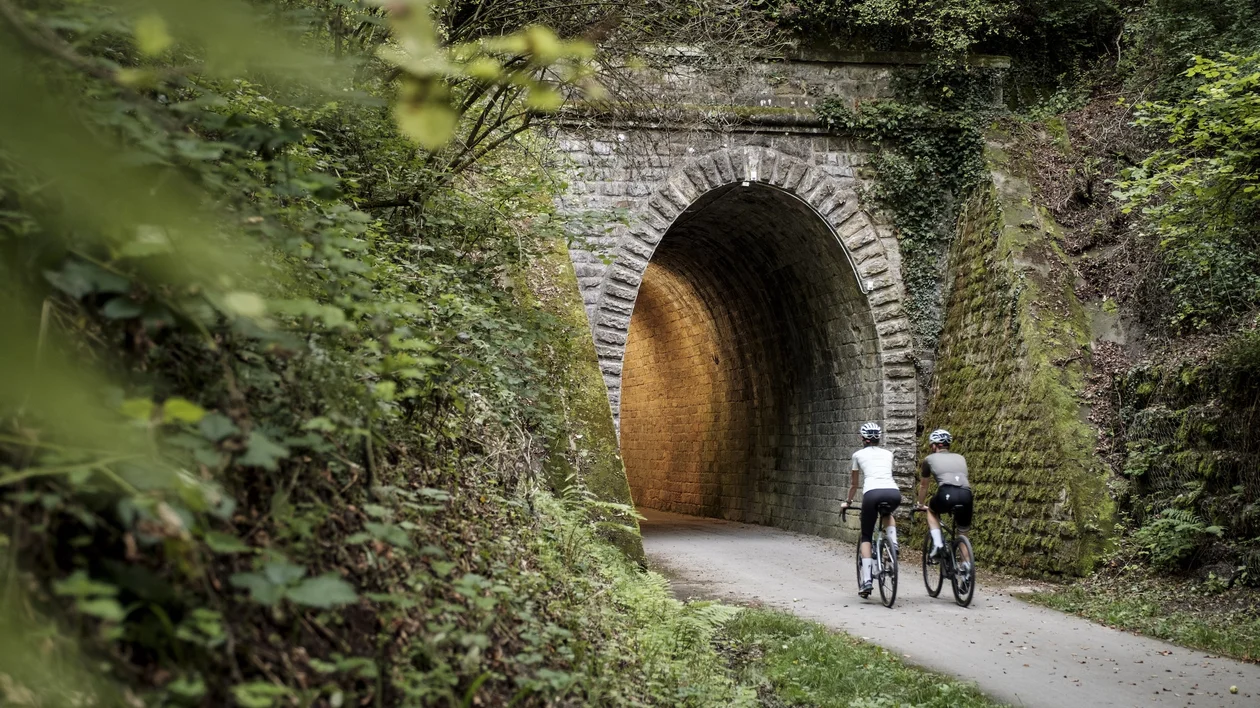
Two cyclists approach a stone-lined tunnel on a greenway, with the route’s transport heritage still visible in the landscape.
Greenways in Italy
Italy has many beautiful greenways, most of them built along former railway lines. The edition of the Atlas of Greenways on FS Railway Lines – From Disuse to Reuse was prepared by RFI – Rete Ferroviaria Italiana (Italian Railway Network), with contributions from the Italian Greenways Association. It presents 32 greenways built on former railway lines, totaling about 500 kilometers.
The Atlas offers practical information for planning trips on high-quality greenways through some of Italy's most spectacular landscapes, from the Alps to the coast. It also encourages bike-and-rail travel by highlighting appealing cycling itineraries that are easy to reach by regional train from across Italy.
The Alpe Adria cycle route: from the Alps to the Adriatic
Alpe Adria is one of the most iconic routes. This cross-border cycle route runs through Italy and Austria, linking Salzburg with Villach, Udine, Aquileia and Grado. It crosses the natural barrier of the Alps and creates a direct connection between Central Europe's cycle networks and the Adriatic Sea.
The route covers about 415 kilometers and is usually ridden in eight stages, through a remarkable variety of landscapes, cultures and cuisines. This cicloviamakes crossing the Alps easy and takes in Salzburg's UNESCO heritage, the ancient Roman city of Aquileia and the extraordinary star-shaped Renaissance fortress town of Palmanova.
One distinctive feature is the route's use of former railway corridors, tunnels, viaducts and dedicated cycle paths. These make the Alpine crossing possible for a wide range of cyclists, not just experienced mountain riders. For much of its length the route follows river valleys and historic transport corridors, pairing spectacular scenery with relatively gentle gradients.
The most spectacular section is the Canal del Ferro, where the former railway line follows the narrow Fella Valley through a string of tunnels, bridges and viaducts. Historic stations such as Ugovizza have been given new uses, including as refreshment stops for cyclists. Excellent infrastructure, railway heritage, scenic mountains and rivers, and historic towns have made Alpe Adria one of Europe's most popular cross-border cycle routes.
La Lunga Via delle Dolomiti: a railway Greenway through the Dolomites
Another important greenway in northeastern France is the 130.5 kilometers Trans-Ardennes Greenway, which follows the former Meuse towpath between Givet, on the Belgian border, and Mouzon, in the Ardennes department of the Grand Est region. Mouzon combines medieval heritage, religious architecture and industrial history and is designated a Petite Cité de Caractère (“Small Town of Character”). The greenway offers a smooth, largely traffic-free journey through a steep-sided, wooded valley. Along the way, cyclists pass historic towns and villages, remnants of the region’s waterways and industrial heritage, locks, bridges and tunnels, while boats continue to navigate the Meuse alongside the route. The greenway forms part of EuroVelo 19 – Meuse Cycle Route (La Meuse à vélo) and connects with the Belgian RAVeL network in Wallonia. We particularly recommend the 31.5-kilometer cross-border section between Givet and Fumay. Fumay itself is known as the “Slate City” in recognition of its industrial heritage, particularly its former slate quarries, and the elegant blue-grey slate roofs that characterize its townscape.
Surrounded by the UNESCO-listed Dolomites, the route combines spectacular mountain scenery with remarkable railway heritage, including historic stations, tunnels, bridges and other engineering works. The route has a gentle profile and runs mostly downhill toward Calalzo, so it suits both cyclists and walkers. Along the way, visitors pass through forests and Alpine valleys with views of iconic peaks such as the Tofane, Pelmo, Sorapiss, Antelao and the Marmarole range.
The route is culturally rich too, connecting historic mountain villages, Gothic churches, museums and Pieve di Cadore, birthplace of the Renaissance painter Titian. It links well with train-and-bike and bus-and-bike services, bike rental and longer cycle routes toward Austria and Venice. The Lunga Via delle Dolomiti is a flagship example of converting a railway into a greenway, combining active travel, heritage conservation and sustainable tourism.
Via Verde della Costa dei Trabocchi (Abruzzo)
If you prefer gentle coastal landscapes, discover the Via Verde della Costa dei Trabocchi, one of Italy's most scenic rail trails. It follows the former Adriatic railway line along the Abruzzo coast for 42 kilometers between Ortona and Vasto Marina. The route offers an unbroken journey for cyclists, walkers and other active travelers, with spectacular views of the Adriatic Sea.
The greenway is named after the trabocchi, traditional wooden fishing platforms built on stilts over the sea and unique to the Abruzzo coast. Along the way are beaches, cliffs, vineyards, nature reserves, historic villages and restored railway infrastructure, making the route ideal for slow travel. A wide choice of hotels, campsites, B&Bs and vacation rentals makes it easy to explore different stretches of the coast by bike or on foot. The journey also celebrates Abruzzo's culinary heritage, from fresh seafood served on the iconic trabocchi to the region's distinctive food and wine traditions.
The Monte Ciocci Greenway: an urban Greenway in Rome
The Monte Ciocci Greenway in Rome is a great example of a city greenway. This path for cyclists and pedestrians is part of the Via Francigena, one of the three great pilgrimage routes of the Middle Ages. It connects Monte Ciocci Urban Park with St. Peter's, crossing a disused railway bridge and tunnel before reaching the "Jasmine Walk" along the Vatican railway line.
The greenway has helped redevelop Jubilee sites, encouraged sustainable travel for pilgrims, residents and cycle tourists, and given disused railway infrastructure a new life. The project is a significant step for sustainable mobility and urban regeneration in western Rome. It offers breathtaking views of the city skyline, dominated by the dome of St. Peter's Basilica just a few hundred meters away. The Monte Ciocci Greenway won the European Greenways Award in 2025.
Enjoy the romantic greenways of France and Italy by bike or on foot, with friends and family. They're accessible to all!
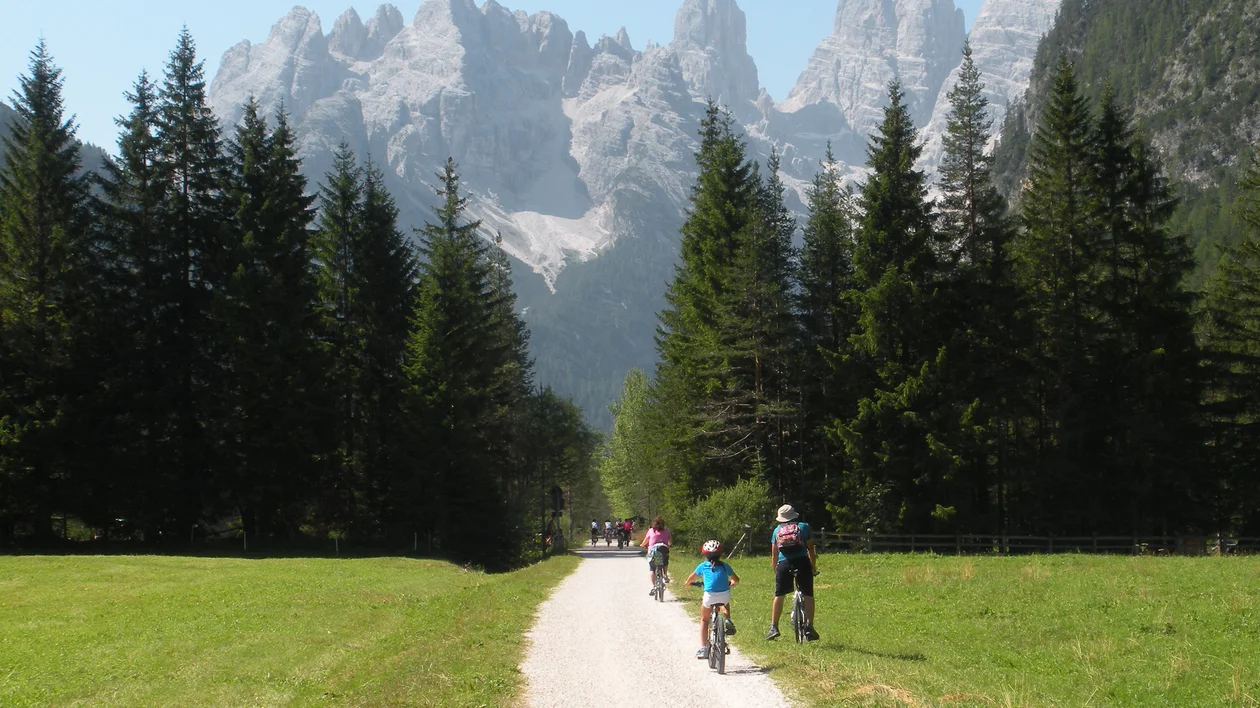
Pedal through pine forests beneath the Dolomites’ towering peaks and let the greenway set your pace.